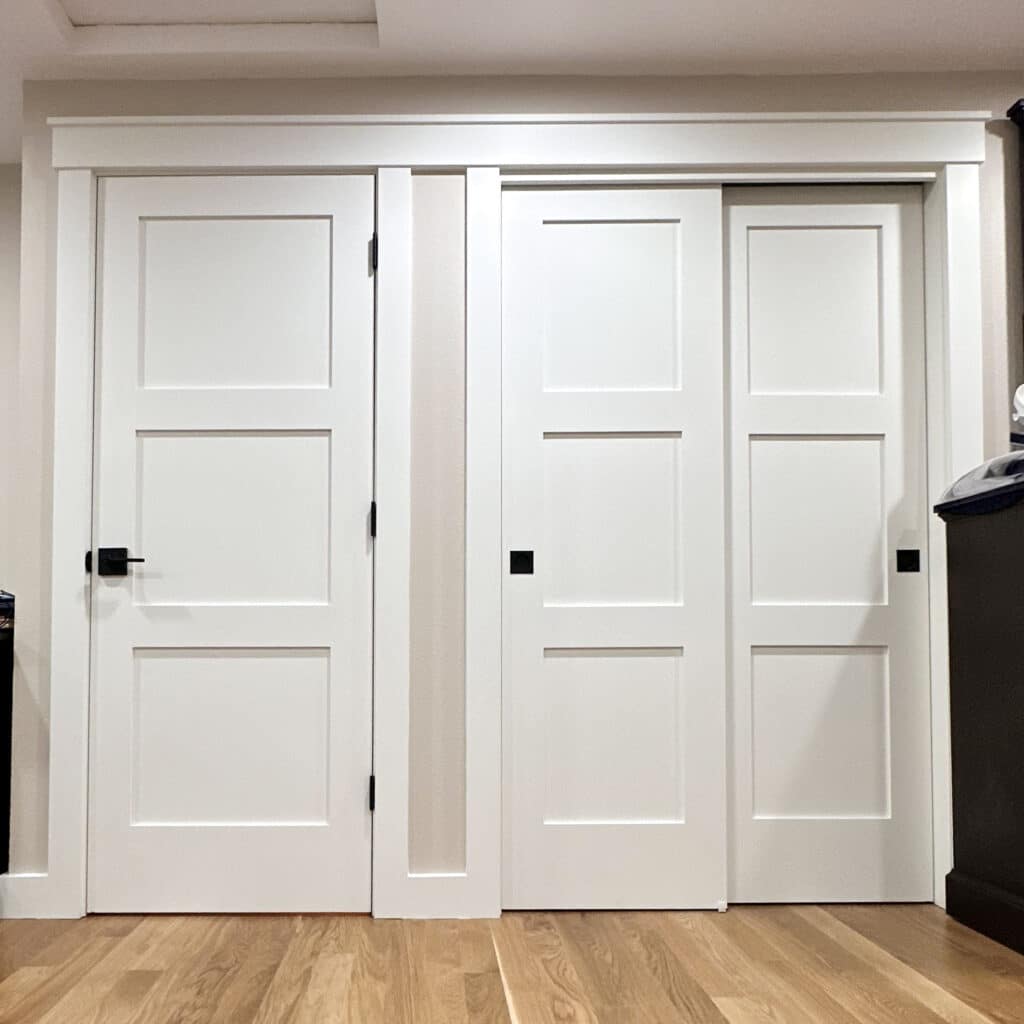
Why Does Trim Look Right in Some Rooms and Wrong in Others? A Seattle Finish Carpenter Explains
Short answer: It’s almost always proportion, not material. When a room feels resolved, the baseboard and casing are sized in proper relationship to each other and to the ceiling height. When a room feels cheap or “off,” those proportions are wrong, even if the trim itself is well-installed. The oldest tool we have for getting these proportions right is the golden ratio, a number near 1.618 that’s been used in Western architecture for over two thousand years.
This post is the long version of that answer. We get this question constantly from homeowners in Queen Anne, Magnolia, Madison Park, and the older neighborhoods around Seattle where original woodwork sits next to remodeled rooms that don’t quite work. By the end, you’ll know how to diagnose the problem in your own home and what to ask for when you hire someone to fix it.
What Is the Golden Ratio?
The golden ratio is approximately 1.618. It gets the Greek letter phi (φ) because Greek mathematicians formalized it around 300 BC, though the proportion shows up in older Egyptian work too.
The definition is simple. Take a line. Divide it into two parts so the smaller part relates to the larger part the same way the larger part relates to the whole. The ratio you get is 1.618.
In carpentry terms, the math is even simpler. You have a dimension you’ve already committed to. Multiply by 1.618 or divide by 1.618 to find a companion dimension that will read as proportionally correct.
A few examples:
- An 18-inch wide cabinet door pairs with a height around 29 inches.
- A 36-inch tall bookcase reads well at about 22 inches wide.
- With a 9-foot ceiling, the relationship between baseboard and casing follows the same proportional logic.
You don’t actually need a calculator on the job. The Fibonacci sequence (1, 2, 3, 5, 8, 13, 21, 34, 55) approximates the golden ratio as it climbs, so paired dimensions of 13 and 21 inches, or 21 and 34 inches, will all read as proportionally pleasing without doing any math.
Where the Golden Ratio Shows Up in Finish Carpentry
Once you start looking, you see it everywhere in carpentry that has lasted.
Cabinet Doors and Panels
Frame-and-panel doors from the 18th and 19th centuries lean on golden proportions constantly. The proportion shows up twice: once in the door’s overall shape, and again in the relationship between the rails and stiles and the panel opening inside them.
Stair Newels and Balusters
Look at any well-detailed Federal or Colonial Revival staircase. The proportion of the newel base to the shaft to the cap, the height of the handrail relative to the baluster spacing, the size of the volute relative to the post. It’s all proportional, and a lot of it is golden.
Built-Ins
The ratio of a bookcase’s upper section to its lower section. The depth of the case relative to the face frame. The width of bays in a long run of cabinetry. When a built-in feels like it belongs in the room rather than imposing on it, proportion is doing the work.
Baseboard and Casing
The relationship between baseboard and casing is one of the clearest places proportion shows up in everyday finish carpentry. Base wants to be the heaviest piece in the room. Casing should relate to it but not match it. When the two are sized correctly relative to ceiling height, the room feels resolved without anyone being able to point to why.
Why Does Proportion Look Right?
The honest answer is that nobody fully knows. There are theories. Our eyes evolved to recognize patterns in nature, and the golden ratio shows up in nautilus shells, sunflower seed heads, the spiral of a fern, and the proportions of a human face. The argument goes that we read it as familiar without registering why.
What we can say with confidence is that the golden ratio is a self-similar proportion. Divide a golden rectangle and you get a smaller golden rectangle plus a square. Divide that smaller rectangle the same way and you get an even smaller golden rectangle. The proportion repeats at every scale, which means a piece designed with golden proportions stays coherent whether you’re looking at the whole built-in or just one drawer front. Nothing fights with anything else.
That coherence is what people are reading when they say “it just looks right.”
Why Does My Trim Look Wrong? A Diagnostic Checklist
Most of what reads as cheap or clumsy in residential construction is a proportion problem before it’s a material problem. Here’s how to check your own home.
Your Cabinet Doors Look Squat
Doors that are nearly square almost always look wrong. Either taller and narrower or shorter and wider would resolve them. Square reads as undecided. Fix: Aim for a height-to-width ratio between 1.4:1 and 1.7:1 for most cabinet doors.
Your Newel Post Looks Flimsy
A 3-inch newel on a wide stair reads as temporary no matter how good the species or the joinery. The post has to relate proportionally to the rail, the run, and the opening. Fix: Substantial newels (5 to 6 inches square or larger) on substantial stairs.
Your Baseboard Looks Underfed
The standard 3-1/4 inch builder-grade base is the single most common reason new construction trim looks cheap. It’s undersized for nearly any room. Fix: Step up to 1×5 (4-1/2 in actual) for 8-foot ceilings, 1×6 (5-1/2 in) for 9-foot, and heavier from there.
All Your Trim Is the Same Width
Casing and base sized the same flatten the room. The proportional hierarchy is what gives a room depth. Base wants to be the heaviest, casing one step lighter. Fix: Set the base first, then size casing one nominal dimension below it.
The pattern in all of these is the same. The proportion isn’t holding up the relationships in the room, so the eye keeps catching on the parts instead of taking in the whole.
What Are the Right Trim Sizes for My Seattle Home?
Most homes in Seattle’s older neighborhoods (Queen Anne, Capitol Hill, Magnolia, Wallingford, Ballard) were built between 1900 and 1940 with 8- to 9-foot ceilings. New construction and recent remodels often go higher.
Here’s how Burl sizes baseboard and casing based on ceiling height. We use dimensional 1x lumber, which gives us a clean step between sizes and the substantial feel that proportional design calls for.
| Ceiling height | Baseboard | Door casing |
|---|---|---|
| 8 feet | 1×5 (4-1/2 in) | 1×4 (3-1/2 in) |
| 9 feet | 1×6 (5-1/2 in) | 1×5 (4-1/2 in) |
| 10 feet | 1×8 (7-1/4 in) | 1×6 (5-1/2 in) |
| 12 feet | 1×10 (9-1/4 in) | 1×8 (7-1/4 in) |
The pattern: base scales up with ceiling height, and casing follows one nominal size behind. This keeps the proportional hierarchy intact while giving each room the substantial feel it earns from its ceiling height.
These are starting points. The room itself, the door size, the window proportions, and the architectural style all push the numbers around. A Craftsman bungalow in Wallingford gets different trim than a Capitol Hill Tudor or a modern Madison Park new-build.
Is the Golden Ratio the Only Proportional System That Works?
No. Two honest caveats worth knowing.
First, a lot of “golden ratio in famous buildings” claims are retrofitted. The Parthenon and Notre Dame weren’t designed with phi in mind. People measured them later and found ratios close to golden, but the measurements get fudged to fit, and other ratios fit just as well. The mystique around phi is overstated.
Second, the golden ratio is not the only proportional system that works. The 1:√2 ratio (the same one used in A-series paper sizing) holds up beautifully. Simple whole-number ratios like 2:3 and 3:5 produce results indistinguishable from golden in most applications. The classical orders use their own proportional systems based on the diameter of the column, and those rooms read as harmonious to anyone who walks into them.
Phi is one tool. It happens to be a good one because it’s self-similar and because it sits close to other ratios our eyes already like. But it’s not magic, and a piece built on 2:3 proportions throughout will read as just as resolved as one built on golden.
How Much Does Proportional Trim Work Cost in Seattle?
A fair question, and one we’d rather answer directly than dodge.
Proportional trim work isn’t priced differently from non-proportional trim work. The labor and material to install a 1×6 base is similar to the labor and material to install a 1×3 base. The difference is mostly in the design phase and in the carpenter’s eye. You’re paying for someone who has thought about ceiling height, door size, room scale, and architectural style before they cut anything.
For Seattle homes, typical 2026 ranges for finish carpentry that includes proportional design:
- Single room of trim (one bedroom or office, base and casing): $2,500 to $5,500
- Whole-floor trim package (base and casing throughout): $12,000 to $30,000 depending on ceiling height and complexity
- Built-ins or paneled walls (designed and installed proportionally): $3,500 to $12,000 depending on scope
Numbers move with species, profile complexity, paint-grade vs. stain-grade, and how much existing trim has to come out first.
How to Use This on Your Own Project
The practical version, on your own renovation or new build, is this.
When a dimension feels arbitrary, try 1.618 times or 0.618 times a dimension you’ve already locked in. See if it resolves the tension. Most of the time it will.
When something looks wrong and you can’t put your finger on why, check the proportions before you check anything else. Nine times out of ten, that’s where the trouble is.
When you’re hiring a finish carpenter, ask them to walk you through their thinking on trim sizing before they cut. If the answer is “we use 3-1/4 base because that’s what we always use,” that’s a flag. If the answer references the ceiling, the doors, the architectural style, and how the trim relates to itself, you’ve got the right person.
The eye knows. Phi is just one of the ways we’ve learned to listen to it.
Frequently Asked Questions
What is the golden ratio in simple terms?
The golden ratio is a number near 1.618. It describes a proportion where the smaller part relates to the larger part the same way the larger part relates to the whole. In carpentry, you use it to size one dimension based on another.
How tall should baseboards be with 8-foot ceilings?
For most Seattle homes with 8-foot ceilings, a 1×5 baseboard (4-1/2 inches actual) is the right call. That’s our standard at Burl. The builder-grade 3-1/4 inch base you’ll see in production homes is undersized for almost any room and is the single most common reason new construction trim looks cheap.
How tall should baseboards be with 9-foot ceilings?
For Seattle homes with 9-foot ceilings, we step up to a 1×6 baseboard (5-1/2 inches actual). This holds the proportional hierarchy with the taller ceiling. Anything smaller starts to read as undersized for the room.
How wide should door casing be?
Casing should sit one nominal size below baseboard. With 8-foot ceilings, that means 1×4 casing (3-1/2 inches) with 1×5 base. With 9-foot ceilings, 1×5 casing (4-1/2 inches) with 1×6 base. The proportional step is what gives the room depth — casing that matches the base flattens everything.
Why does my new construction trim look cheap?
Almost always proportion. Production builders use the same trim sizes regardless of ceiling height to simplify ordering and installation. In rooms over 8 feet, that trim reads as undersized and apologetic.
Can you fix bad trim proportions without ripping everything out?
Sometimes. Adding a backband to existing casing makes it read heavier. Replacing baseboard alone often resets the rest of the room’s proportions enough to work. Burl does this kind of corrective work regularly in Seattle remodels.
Do I need to use the golden ratio specifically?
No. Proportional thinking matters more than the specific ratio. Simple ratios like 2:3 or 3:5 work just as well. The golden ratio is a useful default because it’s self-similar at every scale.
Burl is a finish carpentry and remodeling company based in Seattle, serving Queen Anne, Magnolia, Capitol Hill, Madison Park, Ballard, Wallingford, and surrounding neighborhoods. We’re focused on craftsmanship, transparent pricing, and proportional design that respects the architecture it sits in.