What Does It Cost to Hire Burl? Real Numbers from Seattle’s Finish Carpentry Team
Most contractors won’t tell you what things cost until you’re already committed to a conversation. We think that’s backwards.
If you’re trying to figure out whether a project fits your budget, you deserve real numbers — not a form and a wait. So here they are: the actual price ranges we charge for the work we do most, based on real projects we’ve completed across Seattle.
Before you read on, one thing worth saying plainly: we are not the least expensive option, and we don’t try to be. Burl is a premium finish carpentry team. Any finish carpenter can install trim. What separates a high-end finish carpenter is the standard they hold themselves to: reveals that are consistent to the eye and the tape measure, material that’s been hand-selected for grain and color before it goes on the wall, joints that are cut once and fit right the first time. The work is visible every day in your home — and it should look like it was done by someone who understood that. If quality and making sure the job is done right the first time is important, keep reading.
Interior Door Replacement
Typical all-in cost: approximately $1,100 per door. Minimum project: $1,500.
This price covers everything except door hardware (knobs and levers) and paint — both are intentionally excluded (more on that below).
What’s included:
- Solid-core door slab — we never install hollow-core doors
- On-site door hanging — rather than dropping in a pre-hung factory unit, we hang each door in place so the door fits the actual opening. The result is consistent reveals on all four sides and a door that closes exactly the way it should. On remodels where budget or schedule is the priority, we will install pre-hung units.
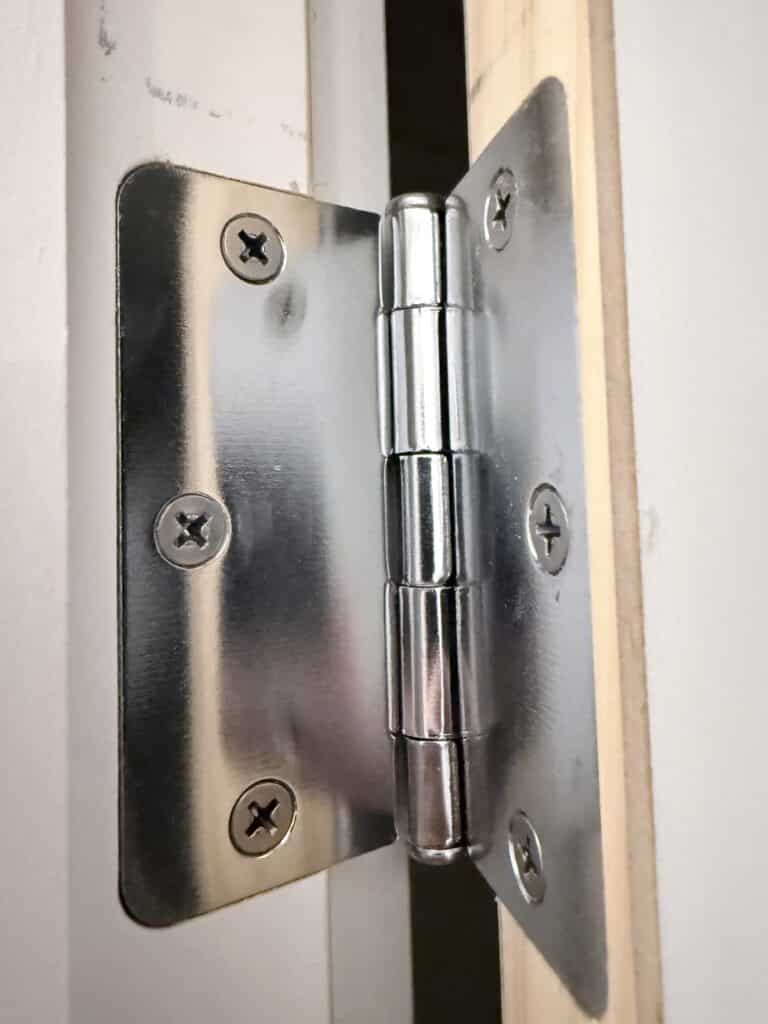
- 1/4″ radius hinges (Schlage or Baldwin) — the 1/4″ radius corner is tighter and crisper-looking than the standard 5/8″ radius found on most production doors and builder hardware. It requires more precise mortising and produces a noticeably cleaner result.
- All site protection: floor covering, furniture protection, dust walls where needed, daily clean-up, and haul-away of all project debris
What pushes cost up:
- The door itself. A mid-grade solid-core slab runs $300–$900. A premium or custom door costs more, and is often the largest single material cost on a door project.
- Existing conditions. A square, plumb, properly shimmed opening is fast to work with. A settled 1920s Seattle Craftsman is not.
- Pre-1978 homes. Lead testing is legally required before disturbing painted surfaces. Additional site prep, clean-up, and documentation adds time and therefore cost.
- Location and access. Parking, condo building logistics, tight stairwells, and limited elevator access all affect project time.
- Casing. Trim around the door is priced separately — see below.
On hardware: For most projects we recommend Schlage or Baldwin. Additional options we work with include Emtek and E.R. Butler & Co. Hardware is a design decision with pricing ranging from $25 to well over $250 per set — we don’t include it in our base pricing, but we’re happy to help you think through options.
Want to learn more? See our door installation overview, our guide to interior doors in Seattle, and why door matching is usually the wrong approach.
Door and Window Casing
Minimum project: $2,500.
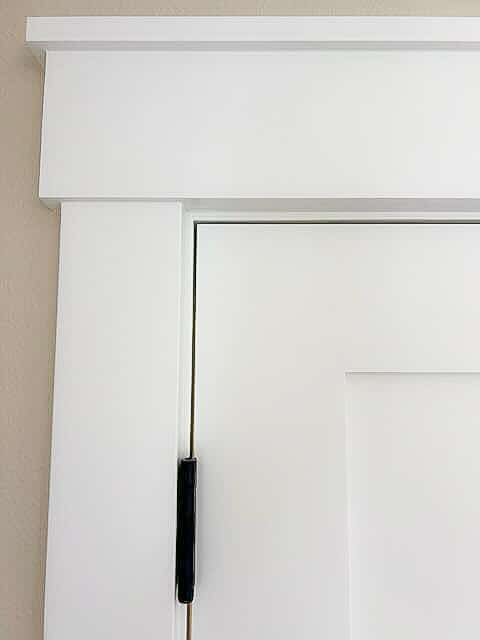
Casing is the trim that frames your doors and windows — one of the most visible finish details in a home, and one of the easiest places to spot the difference between careful work and work that was just close enough. We primarily use WindsorOne solid wood profiles — real wood, not MDF.
Installed casing labor typically runs in the range of $200–$400 per opening, with materials added on top depending on profile width and species.
Paint-grade vs. stain-grade — what it actually means:
Paint-grade casing uses species like maple or birch — stable, closed-grain woods that take paint cleanly. Minor surface imperfections get filled before paint; the paint is the finish.
Stain-grade is a fundamentally different level of work. The finish is transparent, which means every joint, every surface, every gap is visible. Before a single piece goes on the wall, we hand-select each stick of material for consistent grain direction, color, and figure. Mortises are cut tight and clean. Nailing is precise. Glue is removed before it sets. Nothing is hidden by paint. Stain-grade work takes longer and requires a higher level of care at every step — and it costs more accordingly.
Other factors that affect cost:
- Profile width and complexity
- Jamb condition — out-of-plumb or undersized jambs require extension work before casing can go on
- Number of openings — more openings spread mobilization cost across the project
See also: Seattle Trim Work Installation and Why Does Trim Look Right in Some Rooms and Wrong in Others?
Baseboard Replacement
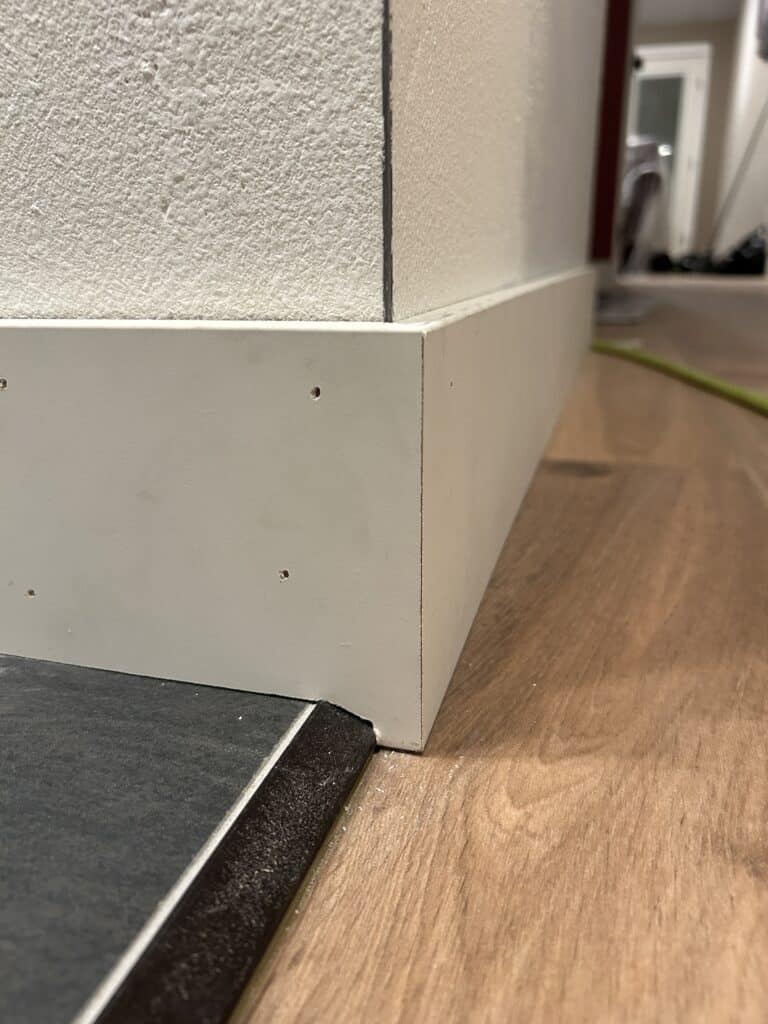
Typical range: $8–$11 per linear foot, installed. Minimum project: $2,500.
This includes demo of existing base, supply and installation of new material, and all site protection and clean-up. Paint is excluded.
We don’t love pricing baseboard by the foot — every project is different — but it’s a useful starting point. In practice, we price based on how many people and how many days a project is likely to take.
What’s included:
- Removal and disposal of existing baseboard
- Supply and installation of new solid wood profile — we use WindsorOne and similar real-wood products, not builder-grade MDF
- All site protection, daily clean-up, and haul-away
- Coping, scribing, and fitting at all corners
What pushes cost up:
- Rooms with complex shapes or high corner counts
- Out-of-level floors — common in older Seattle homes, and doing it right takes time
- Stain-grade profiles requiring hand-selected material and tighter tolerances throughout
- Pre-1978 homes requiring lead testing and additional prep
Custom Built-Ins
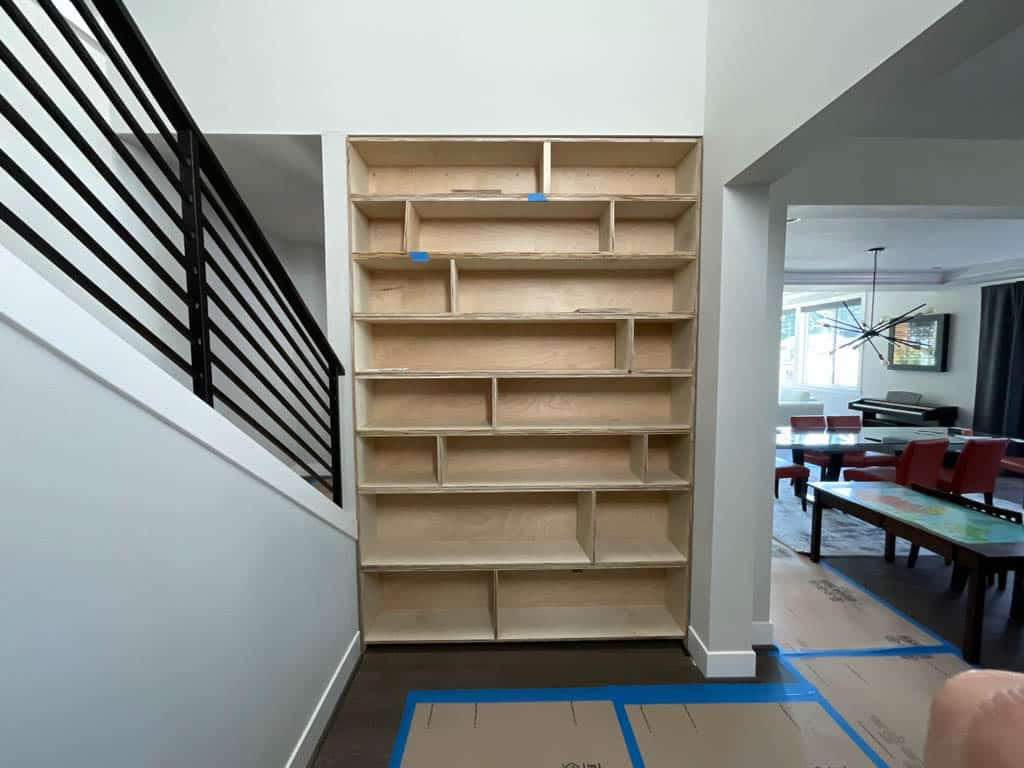
Painted custom built-ins: approximately $1,500 per linear foot, design through installation. Minimum project: $7,500.
Built-ins are among the highest-impact investments you can make in a Seattle home. The $1,500 per foot figure is a real-world average from projects we’ve completed, covering design consultation, shop drawings, fabrication, paint prep, and installation.
What’s not included:
- Paint — always a separate scope (see below)
- Electrical. Built-in lighting or outlet integration requires a licensed electrician. As a licensed general contractor, we can bring a licensed electrician into the project and coordinate the scope — you don’t have to manage it separately.
- Specialty hardware beyond basic hinges
What affects the price:
- Paint-grade vs. stain-grade. Paint-grade built-ins use maple or birch — stable species that take paint well. Stain-grade requires hand-selecting each piece of material for grain direction, color consistency, and figure, and every joint and reveal has to be executed without margin for error. Stain-grade adds meaningful cost.
- Design complexity. Flat-panel doors with clean lines are faster to build and install than inset doors with fitted reveals and custom profiles.
- Scale. A 5-foot bookcase is a different project than a 14-foot floor-to-ceiling entertainment wall.
See also: Custom Cabinetry
A Note on Painting
Painting is always a separate scope on our projects — and intentionally so. On a typical millwork project, painting can run anywhere from equal to the carpentry cost up to three times as much. It deserves its own contract, its own timeline, and a crew that specializes in it.
We partner with painting trade partners we’ve vetted. Most painting teams claim to specialize in millwork; very few actually meet our standards. We coordinate scheduling so the workflow is seamless — sanding, filling, priming, and painting at the right point in the sequence.
Our Approach to Trade Partners
We call them trade partners — not subcontractors. The distinction is intentional. A subcontractor is someone you hand work off to; a trade partner is someone you’ve chosen deliberately, worked alongside, and trust to hold the same standards you hold yourself. That’s how we think about every specialist who comes onto one of your projects.
As a licensed general contractor, we self-perform the work we specialize in: finish carpentry and rot repair. Rot repair is problem-solving work that gets us outside in the summer, which suits the team just fine. Work outside our core — drywall, painting, tile, flooring, electrical, plumbing — we bring in licensed trade partners we’ve worked alongside and trust.
On finish carpentry scopes that exceed our direct team’s availability, we may bring in licensed 1–2 person carpentry crews who meet our quality standards. We’re selective about who works under our name. Frankly, these crews are people we’d hire as W-2 employees when our volume allows for it.
See also: Seattle Dry Rot Repair
How We Price Our Work
We primarily work on a fixed-price basis. Most projects are quoted at a fixed price before work begins, giving you certainty on what you’ll pay.
The underlying math is still grounded in labor rates, material costs, and time — we just build that analysis before the contract rather than billing you as we go. On fixed-price work, we typically add 15–20% above our estimated cost to account for the unexpected: conditions that turn out better than expected sometimes offset conditions that take longer. Over time, it balances out, and you get a number you can rely on. When the situation warrants it — complex remodels, phased projects, or scopes where site conditions are genuinely unknown upfront — we price as time and materials instead.
Labor rates, for reference:
| Role | Typical Rate |
|---|---|
| Lead Carpenter | $130–$150/hr |
| Project Manager | $100–$120/hr |
| Carpenter | $100–$120/hr |
| Laborer / Helper | $70–$90/hr |
Most projects involve a lead carpenter and at least one laborer. Every project includes time for site protection, clean-up, and material handling — we don’t strip those out to make the labor hours look shorter.
On materials and trade partner costs: We mark up materials and trade partner costs. This is how we run a sustainable business, maintain our team, and provide warranty coverage when something needs to be addressed after a project closes. Our markup on materials and trade partner costs typically ranges from 35% to 100%, with larger projects carrying a lower percentage. The markup is part of how we maintain quality control and project coordination throughout — not just a line item.
What’s Always Included
No matter the project size, every Burl job includes:
- Floor and furniture protection before work begins
- Dust walls or plastic barriers where needed
- Daily clean-up throughout the project
- Final clean-up and haul-away of all project debris
We work inside people’s homes. Our team respects that.
Frequently Asked Questions
Do you offer free estimates?
Yes. Fill out our contact form and schedule a free Zoom consultation. During that call, we’ll discuss your project and typically provide a ballpark range before you hang up.
Just like there are different makes, models, and trim levels of cars, we understand we’re not the right fit for every project or every client. If our ballpark aligns with your expectations, we move to one of two paths:
- A fixed-price contract with a deposit, for projects where we have enough information to quote confidently.
- An on-site consultation ($250), where a member of our team — either the owner or lead carpenter — visits your home, reviews the conditions firsthand, and applies their expertise to building an accurate proposal. This is a separate fee, not applied toward the project.
The more transparent we are about pricing, the more efficiently we can serve you — and the fewer surprises anyone has to deal with.
Why don’t you install hollow-core doors?
Hollow-core doors are inexpensive because they’re mostly air. They dent easily, transmit sound, and feel cheap when you close them. Every door we hang is solid-core. It’s a standard we hold ourselves to.
Why hang doors on site instead of using pre-hung units?
Pre-hung doors are assembled in a factory assuming your rough opening is exactly the right size. In Seattle — especially in homes built before 1960 — that’s rarely true. When we hang on site, we fit the door to the actual conditions: actual width, actual plumb, actual level. The result is even reveals on all four sides and a door that closes cleanly. We’ll use pre-hung on projects where budget or schedule is the priority, but on-site hanging is our preference and produces the better result.
Learn more: Why “Door Matching” Sounds Smart — But Rarely Is and A Guide to Interior Door Installation
What’s the difference between 1/4″ radius and 5/8″ radius hinges?
The radius refers to the curve at the corner of the hinge leaf — the part that gets mortised into the door and jamb. A 1/4″ radius has a tighter, crisper corner; a 5/8″ radius is more rounded. The 5/8″ is the production standard because it’s faster to machine at volume. We use 1/4″ radius hinges because the result looks sharper and more refined — and because we’re mortising by hand anyway, the extra precision costs us time, not tooling.
What’s the difference between paint-grade and stain-grade trim?
Paint-grade work uses species like maple or birch — stable, consistent woods that take paint cleanly. Minor imperfections get filled before the finish goes on; it’s excellent work and more forgiving.
Stain-grade is an entirely different standard. The finish is transparent, so there’s nowhere to hide anything. Every piece of material gets hand-selected for grain direction, color consistency, and figure. Mortises are cut clean. Nailing is deliberate. Joints are glued and set carefully. It takes more time, more skill — and costs more.
Learn more: What Is Finish Carpentry? and What Is Millwork?
Do you work on homes built before 1978?
Yes. We hold Lead Renovation, Repair and Painting certification (#R24-0039). Pre-1978 homes require lead testing before disturbing painted surfaces, plus additional site prep, clean-up, and documentation. We factor this into our estimates upfront — not as a surprise line item after the fact.
Can you handle painting?
We bring in painting trade partners who meet our standards on millwork. We coordinate the scheduling so the workflow is seamless — caulk, prime, and paint at the right point in the sequence.
What are your payment terms?
We require a deposit before work begins. Final payment is due at project completion. For larger projects, progress billing milestones are established in the contract upfront.